Lorem ipsum dolor sit amet, consectetur adipiscing elit. Ut elit tellus, luctus nec ullamcorper mattis, pulvinar dapibus leo.
In a world of volatile input markets and shifting geopolitics, the most durable supply chains will be the ones grounded in local biology — not global logistics.
The most resilient supply chain is the one that doesn’t need to import its core inputs. That principle is easy to state and surprisingly rare to find in agriculture.
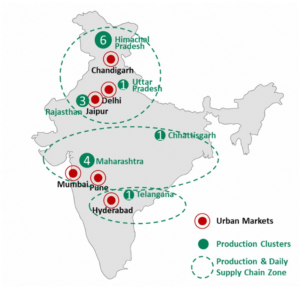
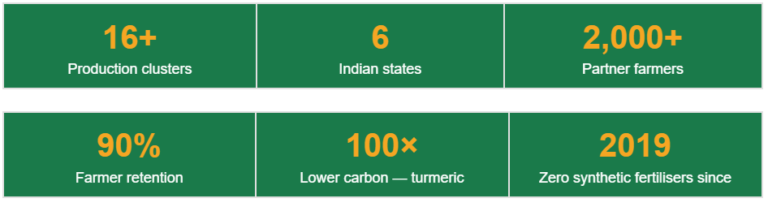
At Urban Farms Co., we’ve been operating on exactly that principle since 2019 — farming without synthetic fertilisers across 16+ production clusters in 6 Indian states, from Himalayan valleys to Rajasthan’s arid plains. Not as a constraint, but as a deliberate scientific and commercial choice.
What that choice looks like, how it works, and why it matters for food businesses making sourcing decisions today is what this article is about. But first — the context that makes this conversation urgent.
The context: a global fertiliser market under structural pressure
The global fertiliser market has been under significant stress since early 2026. The conflict in the Middle East triggered a near-total disruption of shipping through the Strait of Hormuz — a chokepoint through which roughly one-third of global seaborne urea and 20% of global ammonia trade normally passes. The consequences have been swift and measurable.

Sources: FAO, March 2026 · UNCTAD, March 2026 · FinancialContent / Market Minute, March 2026 · CSIS, April 2026
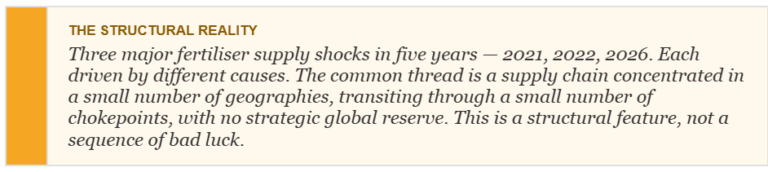
This is not the first time the fertiliser supply chain has buckled. The COVID-19 disruptions of 2021 and the Russia-Ukraine war of 2022 each triggered major price spikes. The 2022 event pushed global fertiliser prices to a 40-year high. The current crisis is, in several respects, more structurally complex: it involves simultaneous disruptions from the Middle East conflict, Russia’s suspension of ammonium nitrate exports in March 2026, and China’s ban on phosphate exports that effectively removed nearly five million tonnes of urea and 40% of global phosphate trade from international markets.
The FAO has projected that global fertiliser prices could average 15–20% higher across the first half of 2026 if disruptions persist. The USDA estimates that corn and wheat acreage plantings in 2026 will likely fall by 3% each relative to 2025. In the United States, 78% of Southern-region farmers reported being unable to afford all needed fertiliser inputs this season.
The longer-term signal is arguably more significant than any single price spike. As IFPRI noted in April 2026, even as new production capacity comes online, it will remain concentrated in countries with access to low-cost natural gas or significant mineral deposits — meaning the structural geographic concentration that creates these vulnerabilities is not being resolved, only expanded. Nations are increasingly treating fertilisers as strategic national assets rather than global commodities, adding a layer of policy risk on top of the existing geopolitical and logistical fragility.
For food businesses and agricultural supply chain managers, this context raises a straightforward question: what does a supply chain look like that is not exposed to this category of risk? The answer lies in where the inputs come from — and what they fundamentally are.
A different premise for plant nutrition
Conventional agriculture and regenerative agriculture share the same goal: feeding plants to produce healthy, abundant crops. Where they differ is in the pathway.
Conventional agriculture delivers plant nutrition as water-soluble inorganic elements — nitrogen, phosphorus, potassium — manufactured externally and applied at the point of need. It is a precise, well-understood system that has fed billions of people.
Regenerative agriculture works from a different scientific premise: that plants have always had access to nutrition through biological pathways — via the symbiotic exchange between plants and the living systems in and around their root zones. The soil microbiome, endophytes (microorganisms living within plant tissue), and the biological networks that have co-evolved with plant life for hundreds of millions of years are, in a healthy soil system, entirely capable of meeting a plant’s nutritional needs. These pathways also generate complex organic compounds that deliver superior nutrition to the plant, supporting higher immunity and crops that contribute to nutrition security.
Our Centre of Excellence researches and applies these pathways directly. The science underpinning them is well-established and increasingly mainstream — covered in journals including Nature Plants, Frontiers in Microbiology, and Science. The practical application, at commercial scale across diverse Indian terrains, is what Urban Farms Co. has been building since 2019.
The infrastructure that makes the science operational
Biology-based farming at scale requires more than scientific knowledge — it requires infrastructure that translates complex science into manageable daily practice for thousands of individual farmers. This is the part of the regenerative model most often underestimated, and the part Urban Farms Co. has invested most heavily in building.
- Regen Agri Hub. Each production cluster is anchored by a physical Hub — a single local point of contact where farmers access high-quality biological inputs, tools, training, and produce aggregation. The Hub converts local organic biomass into farm inputs on circular economy principles. Going regenerative is operationally simpler than staying conventional, not more complex. This independence from external or imported inputs further strengthens operational resilience.
- Regen AgriTech App. A custom-built digital platform designs each farm’s regenerative plan based on regional soil, climate, and crop data. Complex science is translated into clear daily schedules. Real-time tracking provides end-to-end traceability from soil to market — necessary for ESG reporting requirements.
- Centre of Excellence. Ongoing research into biological nutrition pathways and climate-specific growing protocols ensures the science underpinning the model continues to advance. Findings are integrated directly into the AgriTech App and the Regen Agri Hubs, so every farmer in the network benefits from new learning in real time.

Why farmers stay: the economics of the first season
The most honest proof of a farming model’s viability is farmer retention — not trial participation, but the decision to return, season after season, with full knowledge of how the previous season performed.
Our farmer retention rate is 90%. That number is the result of a deliberate design principle: the model must be economically compelling from the very first season, not from year three or five.
Three things make this possible. First, yields in season one are comparable to conventional agriculture — no transition penalty, no sacrifice period. Second, input costs fall as biological inputs replace synthetic ones, improving farm profitability from the outset. Third, the Regen Agri Hub makes the practical transition simpler than maintaining the conventional approach — reducing friction, not adding it.

Carbon outcomes that meet the Scope 3 mandate
For food and beverage businesses, the supply chain conversation in 2026 involves two simultaneous requirements: resilience and measurable sustainability. Regenerative sourcing addresses both.
Third-party Life Cycle Assessment studies verify the carbon outcomes of our produce:
- Carbon-negative okra. Our okra sequesters more carbon than it emits — a net carbon-negative crop at commercial scale.
- 100× lower carbon on turmeric. Our processed turmeric carries a carbon footprint 100 times lower than conventional market alternatives.
- Audit-ready traceability. End-to-end traceability built into the Regen AgriTech App makes all carbon data audit-ready for ESG reporting frameworks including BRSR and CSRD.
For procurement and sustainability teams managing Scope 3 emissions, this combination — verified carbon data, full traceability, and a supply chain whose input costs are structurally independent of global commodity volatility — represents a qualitatively different kind of supplier relationship.
Scale that proves the model is not terrain-specific
One of the persistent questions about regenerative agriculture is whether it scales — or whether it only works in specific soils or climates. Our operational footprint answers this directly.
Six production clusters in the high-altitude Himalayan valleys of Himachal Pradesh demonstrate that the biological nutrition model works without warm-season growing conditions. Three clusters in Rajasthan’s extreme arid heat represent the most demanding test of biological systems under stress. Four clusters across Maharashtra’s semi-arid rain-fed Deccan, and further clusters in MP, Chhattisgarh, Telangana, UP, and Delhi NCR cover every major climatic and soil type India presents.